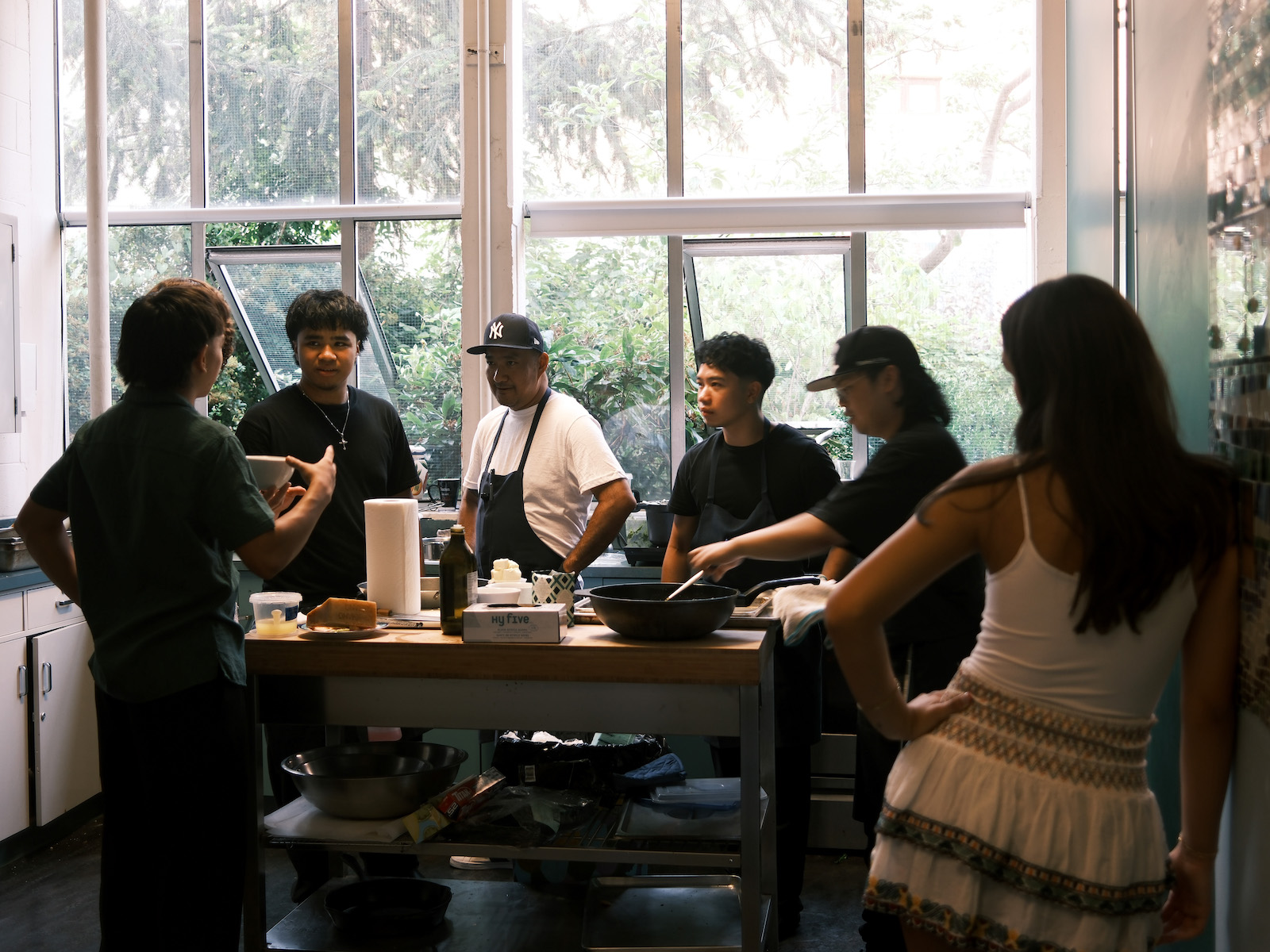

Villa Lobos is a small group of young people who come together around two things: skateboarding and cooking. They’re putting on a dinner next month. Once you hear how it came together, you’ll want to be there.

The Start
A few years ago, King George Secondary teachers Juliana Moore and Shanna Albrecht started a skateboard club. It was a hit. Students showed up and, with Moore and Albrecht’s encouragement, built something very cool. They even raised money to get themselves to Whistler for a skate trip.
On that Whistler trip, Moore noticed the kids passing phones around. She assumed they were sharing skate clips. They weren’t. They were showing each other photos of things they’d cooked.
High school was coming to a close and the feeling of “what’s next” was in the air, but nothing had quite landed yet. These students were showing each other food the same way they’d show a trick they’d been working on. Moore remembers: “They were proud, but not showing off… and the calibre of skill involved in what they were cooking was clearly beyond what most of us were doing in a kitchen at that age. They were already plating with creativity and intention. It was obvious to us that this could be their next step.”
Moore and Albrecht pushed the idea further with three students in particular: David Magallanes Wu, Miguel Villalobos, and Joshua Kamzelski. The five of them started talking seriously about putting on a dinner.
IDENTITY
The alternative program at King George was shutting down, leaving some space. The kids asked if they could use it. The answer was yes. They had a room. Now they needed a name.
They sat in a circle throwing ideas around. Nothing was sticking. Then it hit. Miguel’s last name. Villalobos translated to “Village of Wolves”. It was already there.
The wolf idea runs deeper than branding. “There’s a real sense of a pack forming here. Not just in who’s involved, but in how they’re learning to work together. When wolves howl as a pack, they howl together. They move away from dissonance toward the right tone and try to find each other in that.”
You can see that in how this team is figuring things out. How to communicate. How to give feedback. How to push something forward. “They have a grace… they’re sensitive, they’re empathetic. They come together because they really want to show people a good time.”
Making It Real

Understanding that the next step in helping the crew be ready to share their concept was building a branded identity, Moore called Kenta Goto, a Vancouver-based designer with roots in skate and streetwear, with work across brands like Reigning Champ, Herschel, and Monos, to ask if he could help with a logo that would bring it together and make it feel real. He said yes right away.
When Goto saw the kids, he says it took him straight back to when he started skating in high school, and he came up with something that matched their energy almost immediately. His reference point was The New Deal: “A brand started by skaters that wanted something different and had a certain feeling to it. Their logo wasn’t clean and crisp like the others. It was drawn with crayon by Andy Howell and it stayed that way. It didn’t last long but it was fresh and changed the trajectory of skateboarding. I loved that feeling it gave me.” The Villa Lobos logo carries that same instinct. He told the kids to mess with it, colour it in, make it their own.
Now they had a name. A brand. And a room.

PROOF OF CONCEPT
The first Villa Lobos dinner happened in July. It was called Italian Summer. The core crew, Magallanes Wu, Villalobos, and Kamzelski, pulled in friends for service, dishes, and cleanup. They paid for a school engineer to be on site as per Vancouver School Board regulations and sold 35 tickets to cover costs. They made mocktails and projected skate videos on the wall.

Michelle Pezel of Antisocial Skateboard Shop and Valley Buds Flower Farm showed up with flowers on the tables. Moore’s partner, Adam Flynn, paid for their logo to be mounted on a skateboard deck to use as a sign, scoured thrift shops for candlesticks, and helped set up. The Commodore stepped up with plates and glassware.
At the end of the night, there was money left over. They earned it. They could have pocketed it. They didn’t. They kept it in the project.
ROUND TWO

After the success of that first dinner, Moore saw the momentum clearly and moved on it. She reached out to Macey Budgell at Budgies Burritos to ask if she’d consider letting them use her space for a second dinner. Again: Immediate yes.
“I went to the first dinner at King George, where I also went to school, and I was blown away by these kids,” Budgell says. “I was in shock at how capable they were, and how they’d found this path at such a young age. Whatever is happening with that crew, it’s rare. I just trusted they could do it, and I was right. From set-up to service to cleaning up after, they were absolute pros. What Jules and Shanna have done with that group, giving them the space to reach their full potential, that is a special skill.”

By this point, the project had moved beyond the school, but the structure stayed loose and youth-led. Moore and Albrecht kept showing up on their own time. Connectors, not directors and Dalawa (Tagalog for the number two) went down at Budgies and completely sold out with a fully Filipino menu.
For Head Chef Miguel Villalobos, that choice is personal: “Growing up, I always felt more Canadian than Filipino. I don’t speak Tagalog, and for a long time that made me feel kind of disconnected from that side of myself. But food was the one thing that never felt distant. It was always there, coming home to sinigang on the stove, or showing up to a family party with a tray of my mom’s Filipino spaghetti. That’s how it showed up for me.
The pop-up concept is me going back to that. Not being traditional but also not trying to reinvent the wheel. Just cooking the food I grew up with, using the techniques I’ve picked up working in restaurants.”
Lolo came on board with drinks (Lolo came on board with drinks thanks to Age McInnes and Malania Dela Cruz). Artist Mark DeLong contributed artwork for the walls. Shanna Albrecht printed zines for guests and left them on the tables. Michelle Pezel once again donated flowers.
Again, they rolled the money forward.

NEXT UP…
The team started meeting more regularly in restaurants and cafés, using real spaces to understand how service works. How orders move. How a room flows.
One of those meetings happened at Pizza Coming Soon. GM Shaylen D noticed they were taking notes, asked what they were working on, and once she heard the story, offered them the use of the restaurant on the spot. Not a lot of businesses would be so free with handing the keys to a crew of young people, but Pizza Coming Soon has always operated this way: they pay attention to what people are building and show up for it. Music, art, food, whatever form it takes.

That generosity usually comes from experience, either because someone opened a door for you at the right time, or because no one did and you remember what that felt like. Either way, you know when it’s real. And you know immediately when it isn’t. When you’re being managed, you either push back or go through the motions.
A different dynamic shows up when someone listens and trusts you. And that, more than anything, is what stands out about the way Villa Lobos has evolved. Person after person showing up to watch these kids figure it out without getting in the way, trusting the process enough to give them space and support to try, mess it up, and figure it out. Not hovering. Not disappearing. Just there.
Moore puts it plainly: skateboarding and cooking culture are very similar. You’re watching each other fail towards getting better. If you’re not falling, you’re not skating. Everyone agrees on that.
Nobody in this story had anything to gain in the usual sense. The branding, the flowers, the space, the candlesticks, the time. All of it offered without strings, and it came from a place of trust.
“One of the coolest things about the way everyone showed up… Moore explains “is that it shows the kids that not everything has to be transactional.”
GET SORTED
Villa Lobos will hold their third pop-up dinner at Pizza Coming Soon on May 11th.
Tickets go live April 11.
DM their Instagram for details.
WHY WE CARE
It’s rare to see young people get something off the ground without it getting absorbed by adult agendas. The pattern is familiar: more structure, more oversight, pressure to sustain momentum, and the thing starts to shift. Before long, the focus moves away from the kids and toward fundraising to pay adults to run it. That isn’t happening here. The youth are doing the work, testing ideas, making decisions, carrying it forward. Adults are present but in a supporting role. They open doors, offer space, share time and experience, and step back.
At a time when most people feel too stretched to invest in others without a clear return, the spirit of Villa Lobos matters.


There is 1 comment


Chinatown

A Neighbourhood-Wide Invitation to Wander Chinatown

From Birdhouse to Pony Room: A New Queer Event Space Takes Shape in Chinatown

Chinese Canadian Museum Opens Major New Exhibition ‘Momentum: Power and Identity in Sports’ on June 10, 2026

Announcing June Events at the Chinese Canadian Museum

Villa Lobos: Meet the Crew Behind the Next Dinner at Pizza Coming Soon

Get Ready For Supernova: A New Cocktail Bar Headed for Chinatown
Popular

Ultramar Set to Open in Mount Pleasant This Winter

How Restaurants Change: Thoughts on The New Direction at Les Faux Bourgeois

Casey Greabeiel and Chris Decock on Bringing an Alberta-Born Bar to Vancouver

Amber: A Gastown Listening Lounge Built Around Sound
Get Ready For Supernova: A New Cocktail Bar Headed for Chinatown


Very inspirational! A great model for other packs. And a cool logo, too! A story of light in these times of darkness. Thrive!